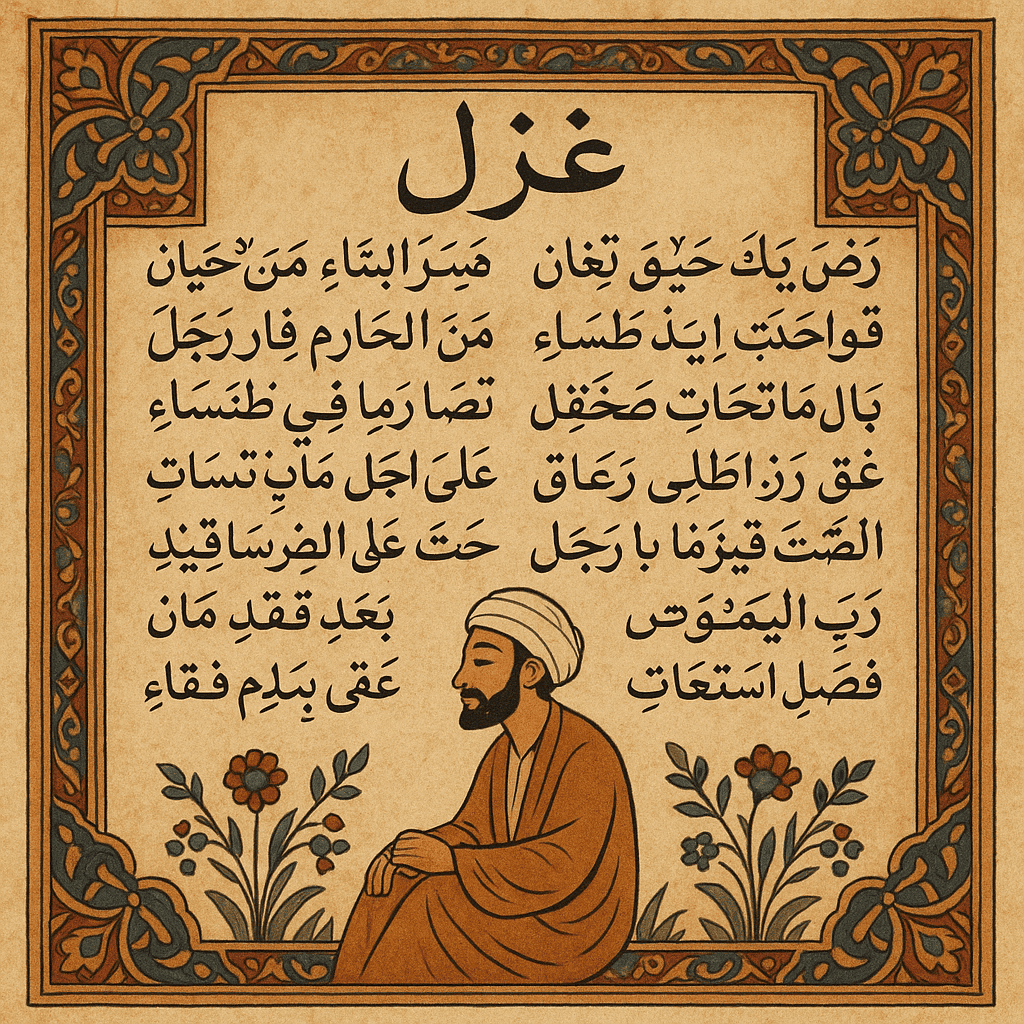
Step into the world of yearning and elegance. The Ghazal: where love aches, the moon sighs, and every couplet is a universe of longing. From ancient Arabic courts to modern coffeehouse poets, the Ghazal has journeyed far and wide.
7th Century Arabia
The Origins of Ghazal
The Ghazal began as a poetic form in 7th-century Arabia, spun off from the longer qasida, focusing on the emotional core of love and longing through couplets with monorhyme and refrain.
Persian poets like Hafez and Rumi polished the Ghazal into a jewel of mystical longing and metaphor, elevating it into a central form of Persian and Sufi literature.
The Ghazal arrived in India through Persian influence, finding a new home in Urdu poetry. Poets like Mirza Ghalib brought it to its golden age, layering the form with rich local flavors.
In the modern era, poets like Agha Shahid Ali introduced the Ghazal to English, preserving its traditional form while tackling themes of diaspora, exile, and heartbreak.